
Navigating Santa at Christmas: A Biblical Parenting Conversation
Also Available on:



On today's podcast, we're discussing Santa Claus and whether it's a bad idea for Christian parents to tell their kids that Santa is real. Every year at Foundation Worldview, we receive a number of questions about Santa, is it okay to tell my kids he's real, or is it a bad idea? This is the question we're going to dive deep into today on the Foundation Worldview Podcast, where we seek to answer your questions so that you can equip the children God has placed in your care to carefully evaluate every idea they encounter and understand the truth of the biblical worldview. I'm your host, Elizabeth Urbanowicz, and I'm thrilled that you've joined me for this episode.
The Short Answer
When we're thinking about this question as Christians—is it bad to tell our children that Santa is real?—I'm going to give you a short answer and then explain.
The short answer is yes, it is a bad idea to tell our children that Santa is real.
I believe this is a bad idea for one primary reason: it's actually wrong to tell our children that Santa is real. Beyond that, there are two additional reasons that make it a very unwise decision. Let me walk through each of these.
Why Telling Kids Santa Is Real Is Wrong
First, why is telling our kids that Santa is real actually wrong? Because it's lying to them. If we tell our children that Santa Claus is real and he's not, we are actively and purposefully deceiving them.
Now, I know the reaction of many will be, "Oh my goodness, Elizabeth, you are being way too serious. This doesn't really count as a lie. We're just engaging in a fun cultural narrative, right?"
Well, a lie is anything that isn't true. And truth is what is real. Is Santa Claus—outside of St. Nicholas who lived hundreds of years ago—real? Is Santa Claus at the North Pole real? No, he is not. So we are actually lying to our kids if we lead them to believe that Santa is real when he is not.
My question for anybody saying, "Well, it's not a big deal. It's a lie, Elizabeth, but it's just for fun"—where in Scripture are we given permission to tell a lie if it's just for fun?
Now, if our children know that Santa Claus is fictitious, that this is just a made-up story, that's different. Then we could potentially engage with Santa Claus—seeing Santa at a shopping center, reading a book about Santa, or watching a movie about Santa—just for fun.
But if we are telling our children or letting them believe that Santa is real, then it's not just for fun. We are actually engaging in deception.
What Scripture Says About Lying
Rather than me trying to convince others that this is lying, let's look at what Scripture actually says about lying. We'll read several different passages—this isn't an exhaustive exploration, but several key passages that speak to this issue.
Exodus 20:16 — The first passage is one we all know, part of the Ten Commandments: "You shall not bear false witness against your neighbor."
Our children are our neighbors. They are those we are called to love, whom God has placed in our household to love. If we are telling them that Santa is real, we are bearing false witness to them.
Proverbs 6:16-19 — "There are six things that the Lord hates, seven that are an abomination to him: haughty eyes, a lying tongue, and hands that shed innocent blood, a heart that devises wicked plans, feet that make haste to run to evil, a false witness who breathes out lies, and one who sows discord among brothers."
Did you notice that two of the seven things listed that God hates have to do with lying, with deceiving others? Two of the things on that list are things God specifically hates.
Colossians 3:8-10 — "But now you must put them all away: anger, wrath, malice, slander, and obscene talk from your mouth. Do not lie to one another, seeing that you have put off the old self with its practices and have put on the new self, which is being renewed in knowledge after the image of its creator."
These three passages make it clear that we are not to lie—no matter our motivation. Lying is wrong because God has commanded us not to do it and because it's an actual affront to God's character. We who bear God's image and who are being more conformed into the image of God's Son each and every day are not reflecting Him when we lie.
Lying Goes Against God's Character
Let me take us through several passages that make this clear.
Numbers 23:19 — "God is not a man, that he should lie, or a son of man, that he should change his mind. Has he said, and will he not do it? Or has he spoken, and will he not fulfill it?"
Speaking the truth is part of God's nature, part of His character. When we go against that, when we lie, we are actually going against His character and nature.
Titus 1:1-2 — Paul opens this letter by writing, "Paul, a servant of God and an apostle of Jesus Christ, for the sake of the faith of God's elect and their knowledge of the truth, which accords with godliness, in hope of eternal life, which God, who never lies, promised before the ages began."
Here Paul is anchoring the hope we have in eternity to what God has spoken, saying this is a sure hope because God never lies. When we lie, we are not only being disobedient—we are going against God's character.
Hebrews 6:17-18 — "So when God desired to show more convincingly to the heirs of the promise the unchangeable character of his purpose, he guaranteed it with an oath, so that by two unchangeable things, in which it is impossible for God to lie, we who have fled for refuge might have strong encouragement to hold fast to the hope set before us."
Our hope anchored in Christ is sure because it's what God has promised, and God never lies.
Even though telling our children about Santa is usually done with good motives, it's a lie. And anytime we are lying, we are disobeying God and going against His character. And anytime we disobey God and go against His character, there are consequences.
Why It's Unwise: Unintended Consequences
Now I'm going to walk us through why telling our kids Santa is real is not only wrong but unwise, because it leads to unintended consequences.
It Can Lead Children to Question God's Existence
First, telling our children that Santa is real is unwise because it will easily lead them to believe that God is also a myth once they discover the truth about Santa.
I remember several years ago hearing Natasha Crain speak on a podcast. She shared how when her kids were little and Christians were saying, "You shouldn't tell your kids about Santa because it's going to lead them to believe that God is a myth," she thought, "Oh please, it's really not that big a deal. It's just a fun thing."
So she told her kids that Santa was real. Then when they got a little older and she told them he wasn't real, they directly asked her, "Does that mean God isn't real either?"
To a child, God and Santa seem somewhat similar. Now, God is very different than the mythical figure of Santa Claus, and we have a preponderance of evidence that God exists where it's very different for Santa. However, to kids, God and Santa seem somewhat similar.
Think about the song: "He sees you when you're sleeping. He knows when you're awake. He knows if you are bad or good, so be good for goodness' sake."
We tell our kids that God is with them all the time—when they're awake and when they're asleep, He's always with us. He knows the good things we've done and He knows the bad things we've done. Now, unlike Santa, God has grace for us through Jesus, and His love for us is not based on our merit but on His love for us and on the finished work of Christ. But in our kids' minds, God and Santa are very similar.
As I mentioned, there is so much evidence for the existence of God, and we want to train our kids to understand this and to seek out the evidence. However, on this journey of discipleship—which is our primary goal for our children, to disciple them, to make them disciples of Jesus—we are taking several steps backward if we convince them that Santa is real.
We lie to them and get them to believe in Santa whom they cannot see, yet believe in. Then somehow we expect that once they find out the truth—that they've been lied to and Santa isn't real—that they'll trust us when we say God, whom they also cannot see yet believe in, is real and we have not been lying to them about God.
This is one of the reasons why telling our kids that Santa is real is very unwise. It will take us several steps back on the journey of discipleship.
It Leads to a Secular Focus at Christmas
The second reason why telling our children Santa is real is unwise is because it leads to a secular focus at Christmas.
Including some secular elements, some cultural celebrations, into our Christmas routines isn't necessarily a bad thing. However, making that the focus is a bad thing. If we are making the focus on these gifts, we are actually taking away from the greatest gift that Christmas is all about: celebrating the incarnation.
Incarnation is just a fancy word meaning that God became flesh and dwelt among us.
Think about that for a second. God became flesh and dwelt among us—with us. And while He was here, He lived the perfect life we could never live. He bore the weight of our sin on the cross, dying in our place, and then rose again to new life.
The incarnation is amazing. It is the most amazing thing. And we are going to have our kids focus on some jolly old fat man who brings a few little trinkets on December 25th? What in the world!
We do not want to take away from the amazing awesomeness of the incarnation—of God becoming flesh and dwelling among us. We want to make sure we're not detracting from that focus, and telling our kids that Santa is real definitely takes away from the biblical, reality-based focus.
So What Do We Do With Santa?
You may be thinking, "Okay, I need to give this a little more thought, Elizabeth. I'm not sure that I'm convinced yet." Or you may be thinking, "Okay, Elizabeth, I was already on board with you before we started this podcast."
No matter which place you're in, you might be wondering: what do we do with Santa Claus as Christian parents? How do we guide our kids to interact with all the different elements of Santa Claus that we're going to find in the Christmas season?
Keep the Focus on Jesus
My first encouragement is to work extra hard during the season of Advent to keep the focus on Jesus. Have all of the holiday traditions you engage with focused on Jesus. Be intentional about the songs you're listening to, the movies you're watching, the activities you're doing.
I'm not saying you can't ever engage with any form of secular celebration of the holiday, but be intentional about keeping the focus on Christ.
Engage With Santa as a Fun Story
As you think about the character of Santa Claus, you can engage with Santa for fun, but make sure your children know that he's just a myth—that he's not real. The person you see at the library or the shopping center is a nice man dressed in a red suit and a beard, pretending to be Santa Claus. But always bring the focus back to Christ.
I remember when I was growing up, my mom did a great job of this. My mom and dad always told us that Santa Claus was not real, but usually during every Christmas season, we would go to this little shopping center near us in New York—the Beach Shopping Center—and we would visit Santa who was there. I think it was actually at a bank or credit union. We would go, sit on his lap, get a candy cane, and take a picture, then drive home. It was a fun thing for us to do.
We have lots of pictures of us growing up on Santa's lap, but I remember that on the way home, my mom would always talk with us about how the gifts that Jesus has given us in Himself—Him coming to earth, taking on flesh, bearing the weight of our sin, reconciling us to God, giving us eternal life in Himself—how those gifts are infinitely better than any other gifts we can get at Christmas, and any other gifts Santa supposedly would bring to children.
We want to put that focus, keep that focus, on Christ.
Teach the History of Saint Nicholas
If you want to take a different angle, you can actually help your children understand how the legend of Santa Claus began—who the real Saint Nicholas was. You can look up articles or check out children's books on the actual figure of Nicholas and learn how the legend of Santa Claus started. Then bring the focus back to what the truth of history was.
But again, in all of this, we want to put the focus back on Christ, on the incarnation, the amazing miracle that God became flesh and dwelt among us.
Summary
Just as a summary of everything we've covered in this podcast: Yes, telling our children that Santa is real is both wrong because it's lying, and it is unwise because it will easily lead them to question God's existence and will easily lead to a very secular focus on the most amazing miracle of God becoming flesh and dwelling among us.
But we can be wise about interacting with this cultural element of the Christmas season in a very biblical way.
Keep Growing in Biblical Parenting
If you want to train your kids to be children who seek out what is true and know what is true, I highly recommend checking out our two books here at Foundation Worldview: What Is Truth? and Are Feelings Truth? These two books will step by step walk your kids through fun illustrations, stories, and games to get ingrained in their minds what truth is and how truth is different than feeling.
Christmas time is a great time to check them out because they make wonderful gifts—not only for your kids but for nieces, nephews, and grandkids. They also make great stocking stuffers!
Don't miss out on more resources like this. Sign up for the Foundation Worldview email list to receive practical biblical worldview training tips, be the first to know about new resources, and get encouragement for the discipleship journey with the children in your care.
Well, that's a wrap for this episode. As we continue in this Advent season, my prayer for you is that you and the children God has placed in your care would be amazed and in awe of the God who became flesh and dwelt among us. I'll see you next time.
Related Posts and insights
Should Christians Celebrate Christmas? Sorting Fact from Fiction
Is Christmas pagan? Learn how to help your kids think biblically and critically about this claim and celebrate Jesus’ birth with confidence and joy.
Santa Claus, The Easter Bunny, The Tooth Fairy, and the Truth
If we are teaching our children about objective truth, evaluating claims and understanding that the biblical worldview is true, is it harmful or antithetical if we're encouraging belief in Santa Claus or the Easter Bunny or the Tooth Fairy?
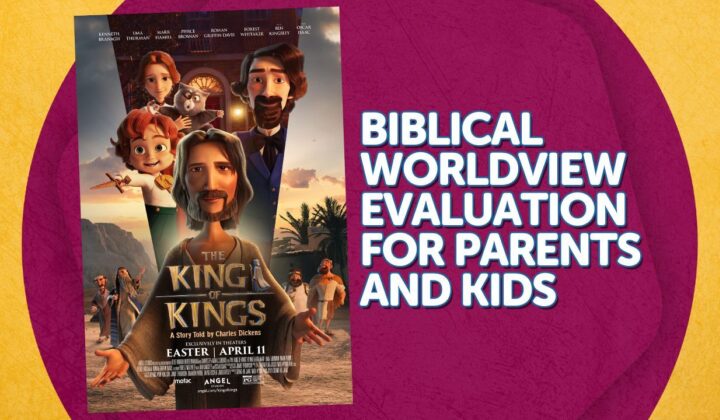
The King of Kings: A Biblical Worldview Evaluation for Parents and Kids
A thoughtful review of The King of Kings movie with biblical insights, pros and cons, and Scripture-based discussion points for Christian families.